
There is a moment, just before sunrise, when the lotus blooms of Hanoi’s West Lake hold their breath. The petals are still folded inward. The dew is cold. The fragrance, still concentrated in the innermost chambers of the flower, has not yet begun to drift away into the morning air. For the artisans who craft Vietnamese Lotus Tea — known locally as trà sen — this fleeting moment is everything. Miss it, and the most precious ingredient is gone forever.
Among the world’s storied tea traditions, Vietnamese Lotus Tea stands entirely apart. It is not merely a scented tea. It is a harmonious balance of subtle floral notes, gentle sweetness, and a smooth, lingering finish — and beyond flavor, it is a centuries-old act of devotion — one that demands more patience, more labor, and more reverence for a single flower than almost any other culinary craft on earth. To understand it is to understand something profound about Vietnamese culture itself: a civilization that has always believed that beauty, pursued with discipline and care, is never wasted.
Vietnamese Lotus Tea is a time-tested tradition that dates back to the feudal era — far removed from a passing trend. Reserved initially for royalty, its labor-intensive preparation is a testament to its elevated status. The lotus flower, Vietnam’s national symbol, represents serenity, calm, and spiritual awakening, and in the cup, this symbolism becomes tangible: drinking lotus tea is a ritual, a sanctuary of quiet in the midst of daily life. Today, though still highly regarded, lotus tea is more accessible than its imperial origins might suggest — savored equally by locals and international visitors who find in it a connection to something irreplaceable.
The History of Vietnamese Lotus Tea, Written in West Lake
Vietnam’s relationship with tea runs extraordinarily deep. The country is home to some of the world’s oldest living tea trees — ancient specimens in northwestern Vietnam (Tây Bắc), including remote mountain slopes in Yên Bái, Hà Giang, and Sơn La that stand ten meters tall, their trunks so wide that two to three people with joined arms are needed to encircle them.
Lotus tea — that singular marriage of flower and leaf — was first refined in the eighteenth century under Lord Trịnh Sâm of the Trịnh Lords, when it emerged within the royal and aristocratic tea culture of Đàng Ngoài and was crafted for the courtly elite. Servants would row out onto West Lake at night, gliding across the water among lotus buds just beginning to bloom, when their fragrance was at its peak. They would carefully fill each blossom with green tea leaves and tie the petals closed with silk thread. By morning, the tea had absorbed the lotus’s concentrated essence. Before the king could take his first sip, servants returned to the pond to collect every drop of dew still resting on the lotus leaves, using it as the water to brew his singular, irreplaceable cup.
This was not merely ceremony. It was a philosophical statement. The lotus — a flower that rises from murky water to bloom in pristine beauty — has long symbolized purity and moral integrity in Vietnamese culture. Scenting the emperor’s tea with its fragrance was to offer him something immaculate: the spiritual essence of the earth itself.
Đấy vàng đây cũng đồng đen.
Đấy hoa thiên lý, đây Sen Tây Hồ.
Literal Translation: “There lies gold, here lies black bronze.
There blooms the celestial flower, here the lotus of West Lake.”
To fully understand how this tradition was born and perfected, we must turn to its deeper historical origins.
Why West Lake — and only West Lake
Not just any lotus will do. Among all of Vietnam’s lotus-growing regions — including Hà Nam, Hải Phòng, Đồng Tháp, and others — only the lotus of Hanoi’s West Lake meets the exacting standards required for authentic lotus tea. The reasons are both agricultural and spiritual.
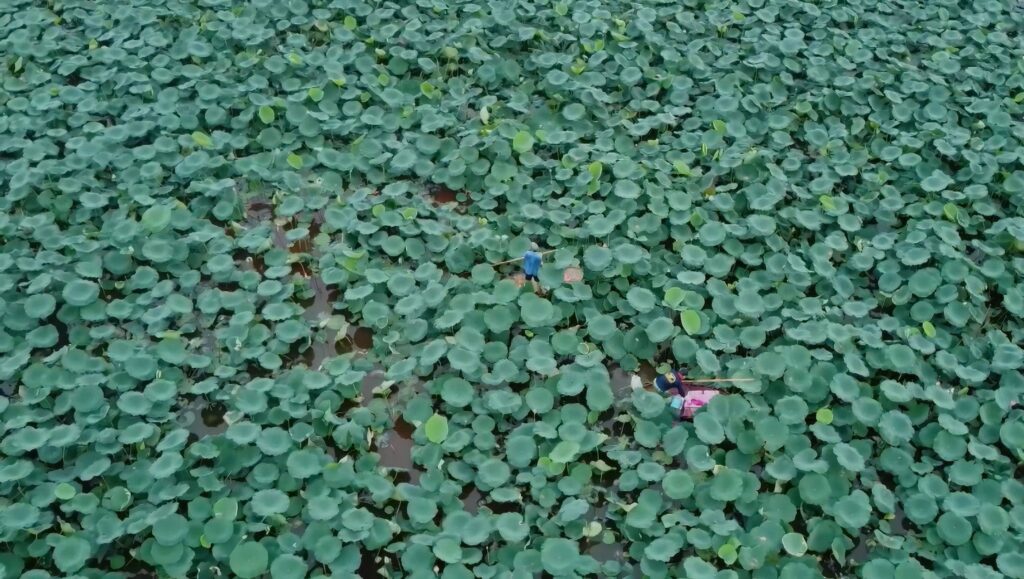
The exceptionally fertile mud of West Lake produces notably larger, double-petaled pink blossoms. Research comparing West Lake lotuses with those from Phủ Lý found that West Lake flowers yield approximately one hundred twenty grams of lotus stamens per hundred flowers, compared to only eighty grams from Phủ Lý — nearly fifty percent more. The lotus flowers of West Lake carry a fragrance that is distinctly more elegant and refined than those grown in other regions.
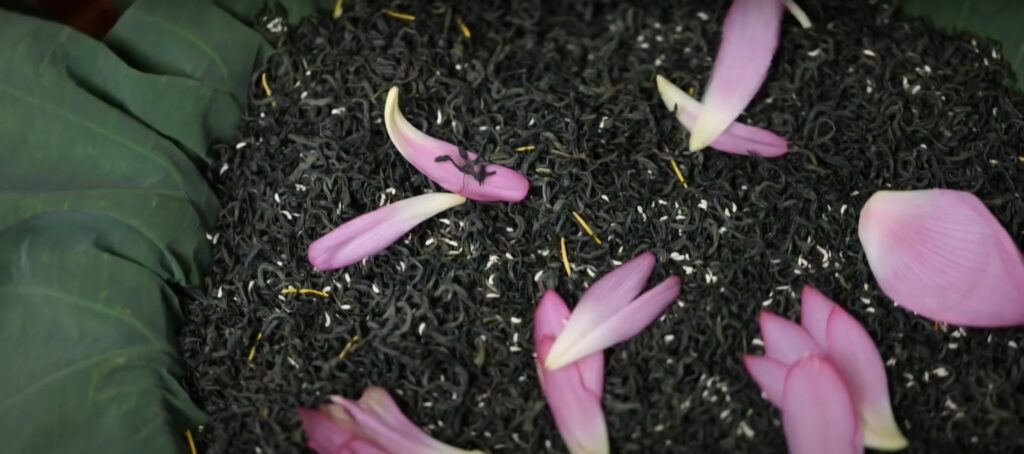
The specific cultivar used is the Bách Diệp lotus, a rare local breed whose name means “Hundred-Petaled Lotus.” Its outer petals are broad and graceful, growing smaller toward the flower’s core, where the yellow stamens bear the precious white rice-like grains. This is the part — and only this part — that artisans use to scent the tea.
West Lake’s lotus possesses one additional, crucial trait: its blossoms open before sunrise. This means harvest must begin at four in the morning — or even three, when blooming conditions are right. Once the sun rises and the flowers fully open, the fragrance dissipates into the air. For the artisans of Quảng An village, working in the predawn dark is not dramatic flourish. It is the only way.
The Art of Handcrafting Vietnamese Lotus Tea
What happens after the flowers are harvested is where Vietnamese Lotus Tea transforms from impressive to truly remarkable. Extracting the lotus rice (anthers) from each blossom is itself a skilled art. The overnight-bloomed flowers are extremely moist. Too much force crushes the delicate lotus rice and destroys its fragrance; too little, and the rice remains tangled in the stamen threads. Master artisans develop a touch refined through experience, with fingers moving across the stamens to complete each flower in seconds.
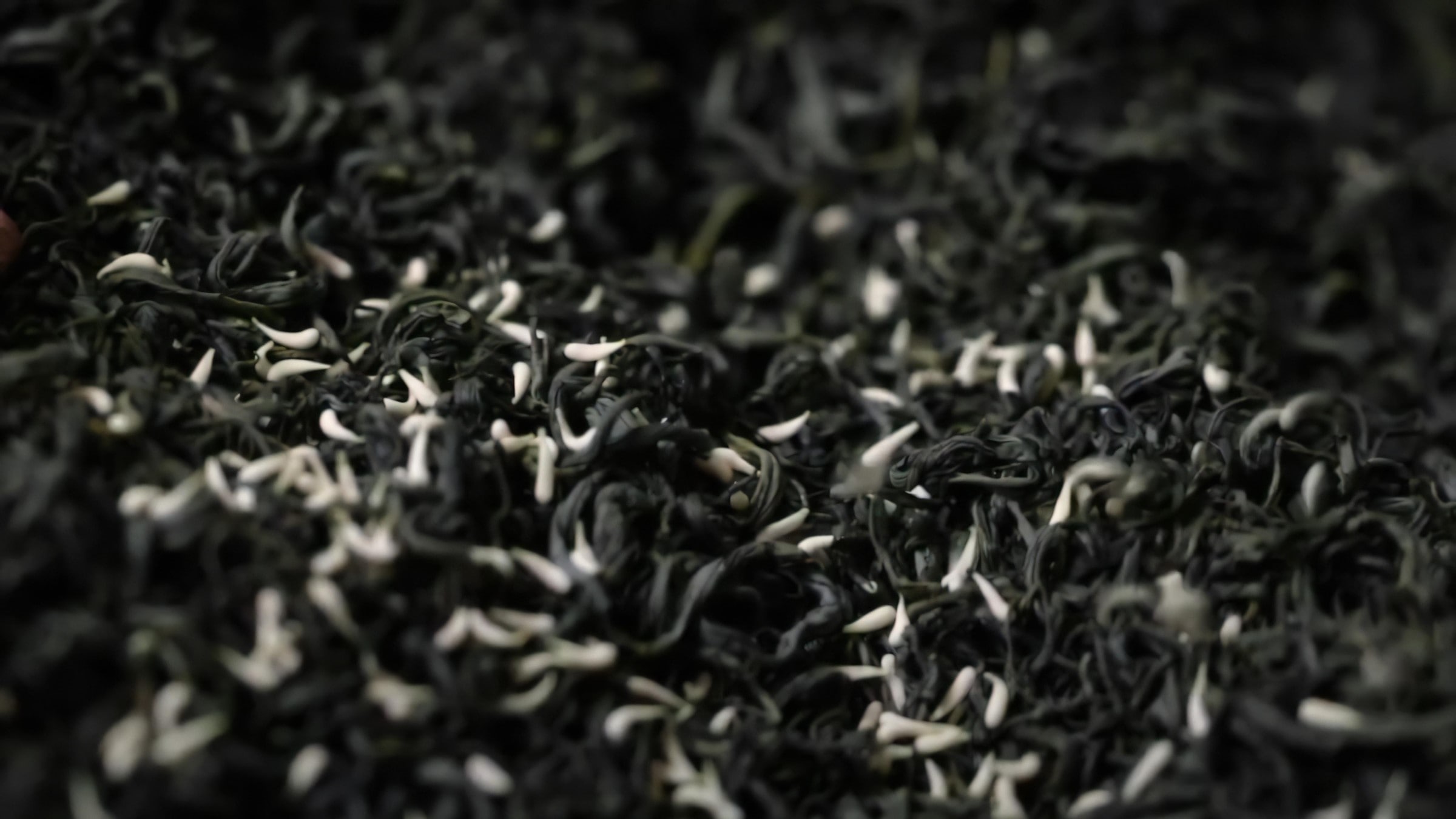
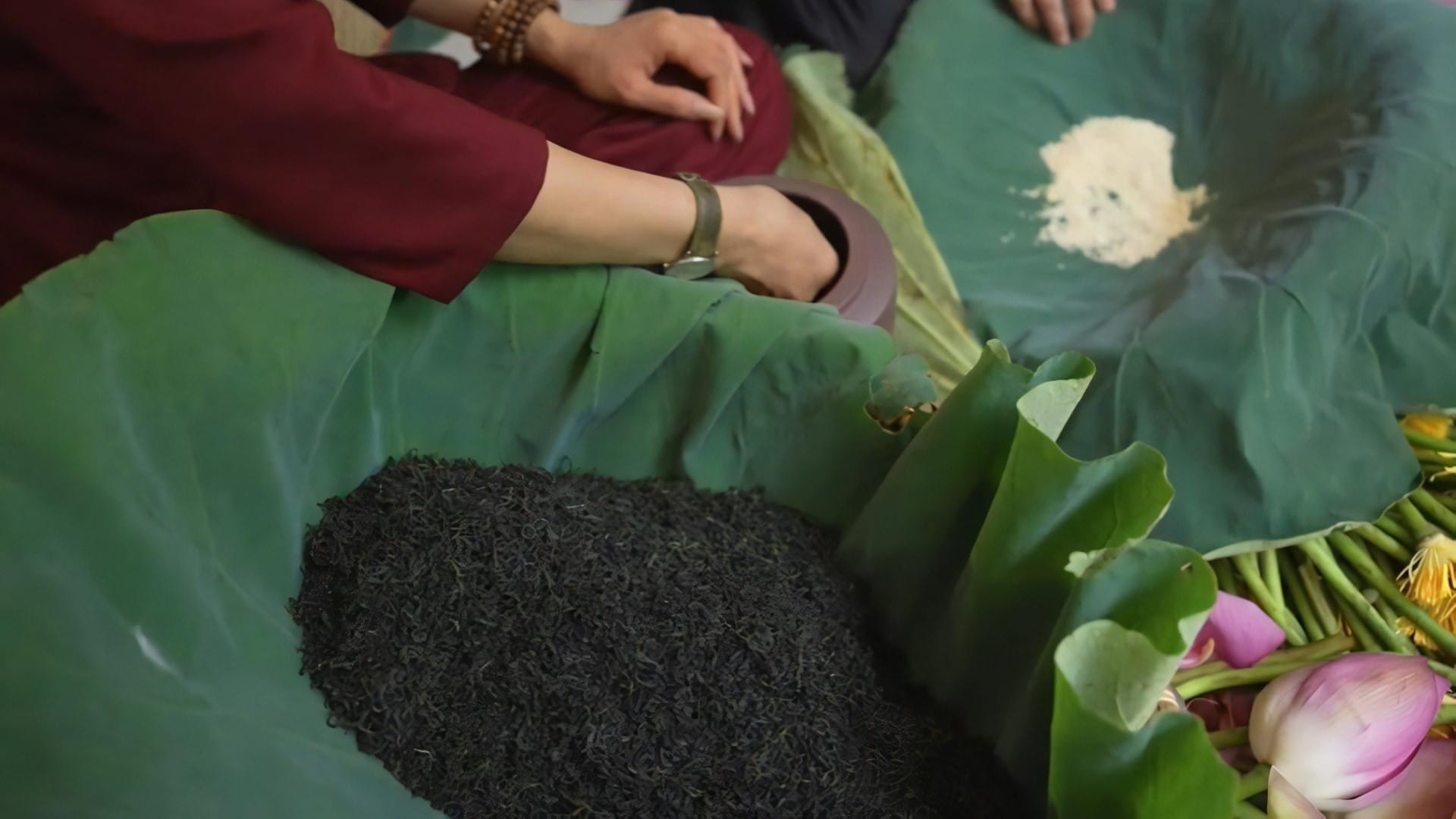
Once the lotus rice is extracted, the scenting process begins. Artisans build alternating layers inside a sealed earthenware crock: a thin spread of tea, then a fine layer of lotus rice, then tea again, then rice, until both materials are exhausted. The crock is sealed and left to rest — but not undisturbed. Every twenty four hours, the mixture must be opened and gently turned to release heat. Lotus rice carries high moisture, and if the sealed layers overheat, the anthers will spoil and the entire batch must be discarded. This vigilance continues through the day and into the night.
After roughly one and a half to two days, the tea has absorbed the fragrance but has also absorbed considerable moisture. Artisans sift out the spent lotus rice, pack the wet tea into cloth bags, and dry it carefully — traditionally over charcoal fires in tiered drying cabinets, with the heat rising from below to gradually draw out moisture while preserving the captured scent. This balance between removing water and retaining fragrance is, as practitioners describe it, the secret heart of the craft.
And then it begins again. The entire scenting and drying cycle is repeated. Each round requires approximately two hundred lotus flowers per kilogram (2.2 lbs) of tea. Across seven to eight cycles, between one thousand and fifteen hundred West Lake lotus blossoms are needed to create a single kilogram of finished lotus tea. This is not an exaggeration. It is the arithmetic of devotion.
The foundation of this devotion, however, lies not only in the flowers but also in the tea itself — traditionally crafted from some of Vietnam’s finest leaves, especially those from the Tân Cương region of Thái Nguyên or carefully selected ancient tea trees, where the raw material already carries depth, sweetness, and quiet strength before it ever meets the lotus.
Every aspect of lotus tea craftsmanship is governed by strict protocols passed through generations. Because the lotus flower symbolizes purity, the environment of its preparation must remain equally pure. Artisans cannot work in air-conditioned spaces — even in summer heat reaching forty degrees Celsius (104°F) — because artificial cooling causes the lotus stamens to shrivel and lose their fragrance rapidly. Hands must never be washed with soap or touched with any fragrant product before handling the lotus. Visitors participating in lotus tea experiences are asked to wear no perfume whatsoever; a single foreign scent can compromise an entire batch.
Among traditional families, one taboo persists unchanged across generations: women during menstruation must refrain from making lotus tea, as elders maintained that their proximity would cause the lotus to lose its fragrance. This belief, passed without scientific explanation from one generation to the next, speaks to something deeper than superstition — to the reverence with which this craft has always been approached. Lotus tea is not simply manufactured. It is tended.
From Leaf to Liquid: How to Brew Vietnamese Lotus Tea the Traditional Way
The old tea masters of Hanoi never hurried. Their movements at the tea table were measured and composed — calm not as an affectation, but as a genuine expression of how they understood the ritual before them. That quality of presence is, in a very real sense, the first step in preparing a proper cup of lotus tea.
Start by filling the teapot with boiling water. Set the lid back on, then rotate the pot slowly so the hot water coats the entire inner surface. Follow this by pouring boiling water over the outside of the pot as well, warming it from all sides, then drain the pot completely before adding any tea. A pot that is warm to the touch is ready; a cold pot is not.
With the pot still holding its heat, measure in the lotus tea — the amount depending on the pot’s volume and your personal preference for strength. The old practitioners had a phrase for this calibration: “the art of perfect balance.” A brew that is too concentrated overwhelms the nose with fragrance and turns the liquor reddish; one that is too thin simply disappears, leaving nothing worth savoring. Once the leaves are in, pour in enough hot water to reach about halfway, give the pot a gentle swirl, then pour all of it straight out. This first wash rouses the leaves without surrendering their fragrance.
Now fill the pot fully — right up until the water spills over the rim. For those who prefer a bolder cup, water at a full boil (212°F / 100°C) is the choice. For a cleaner, more aromatic result with less astringency, water that has been allowed to cool slightly to around 175–185°F (80–85°C) will serve better. In either case, letting the water overflow the lid serves two purposes: it clears any surface dust, and when the lid is replaced, the overflow forms a tight water seal around the rim that locks heat inside. Pouring a final stream of water over the entire outside of the pot — a practice sometimes called “bathing the pot” — ensures the temperature remains even throughout the vessel.
Set a timer for one to two minutes. While the tea steeps, arrange the cups in a shallow basin and rinse them with boiling water. Warmth in the cup is not a minor courtesy — it is considered one of the essential marks of well-made Vietnamese tea. A cold cup pulls heat from the liquor the moment it is poured, dulling the fragrance before it ever reaches the drinker.
When the steeping is done, pour from the pot into a serving pitcher, then distribute from the pitcher into each cup. This intermediate step is not a formality — it is what makes every cup identical in strength and character. Those who skip it and pour directly from pot to cup will find the later cups growing steadily more bitter and tannic, eventually burying the lotus fragrance entirely beneath the weight of over-extracted tea. The cup should arrive at the drinker carrying nothing heavier than a whisper of lotus — something light and fleeting, like the scent of a flower passing in the breeze.
Once the first round is poured, resist the urge to discard the spent leaves. They have more to give. Return hot water to the pot, steep again, and repeat the process — multiple rounds are not only possible but expected. Depending on the quality of the tea, anywhere from three to eight steepings can be drawn before the leaves are finally exhausted. To keep each successive round from thinning out noticeably compared to the last, leave a small amount of brewed tea in the pot before adding fresh water. That small reserve acts as a bridge, carrying flavor and fragrance forward from one steeping to the next.
How to truly taste Vietnamese Lotus Tea
The aristocratic culture of imperial Hanoi — the city once known as Thăng Long — developed an entire philosophy of tea appreciation, and lotus tea demands nothing less than its full application. Before lifting the cup, one is meant to release worldly concerns deliberately, allowing the mind to quiet. The cup is held using three fingers in a gesture called tam long giá ngọc: three dragons cradling jade — thumb and index finger at the rim, middle finger supporting the base, the ring finger extended gracefully to the side.
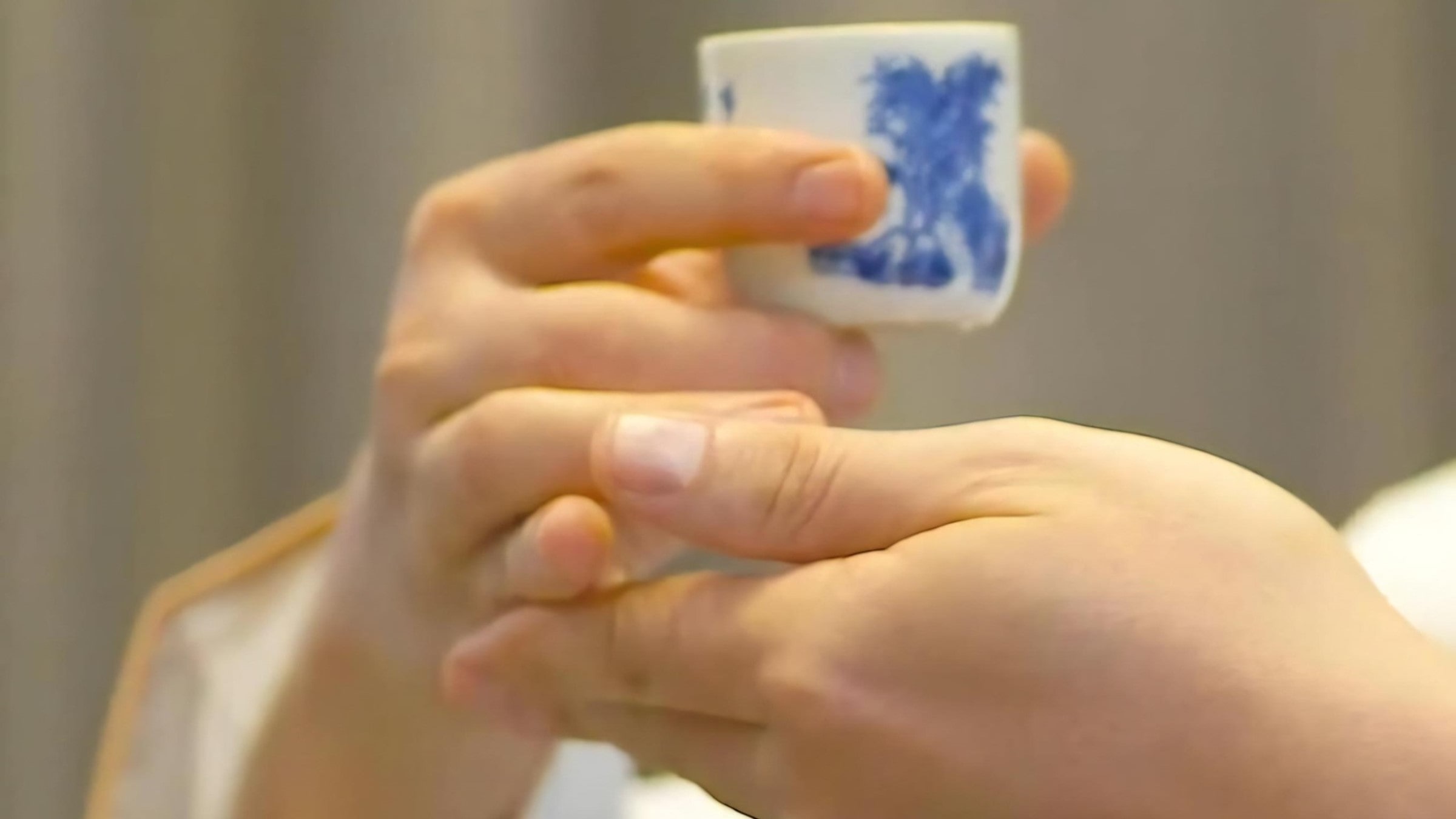
Before drinking, the cup is raised to eye level and moved gently from right to left, a gesture called du lâm sơn thủy — wandering through forests and waters — inviting appreciation of the tea’s visual quality. The cup is then brought near the nose. Only after inhaling the fragrance does one take the first sip — and that sip should rest in the mouth for three to four seconds before swallowing, allowing the lotus perfume to rise through the throat and into the nasal passages. An old Hanoian verse captures the required pace: ascending twelve steps of stairs should take the same time as drinking one cup of tea.
The flavor of authentic West Lake Lotus Tea, when brewed correctly, unfolds as a brew that is crisp yet smooth, with a delicate sweetness that lingers softly on the palate — first the floral fragrance of the lotus, then the gentle astringency of the green tea, and finally a faintly sweet aftertaste that lingers long after the cup is set down. Even before the first sip, bringing the cup close to the nostrils is said to conjure an evocation of the sky, earth, and water of West Lake — swaths of pink blooms unfurling across still water in the early morning light.
In a world that moves at extraordinary speed, Vietnamese Lotus Tea asks something almost radical of us: to stop. To hold a cup with three fingers and feel the warmth. To breathe before drinking. To recognize that the tea in our hands contains sunlight and rain and dew, the labor of farmers who rose before dawn, the skill of artisans who wake their batches through the night. Ancient Vietnamese tea practitioners understood something that contemplative traditions across cultures have long affirmed — that attention, given fully, transforms the ordinary into the sacred. One cup of lotus tea, properly approached, offers exactly that transformation. No other tea in the world does it quite this way. None ever has.
Where to buy Vietnamese Lotus Tea
Finding genuinely authentic Vietnamese Lotus Tea — crafted from West Lake lotus, scented through multiple rounds, and sourced from families who have practiced the craft for generations — requires knowing where to look. Here are the most reliable ways to experience it.
Noble Viet Tea
We partner with artisan families on the Quảng An peninsula — a sliver of land reaching into West Lake that has been the beating heart of Hanoi’s lotus tea tradition for generations. Every tea we offer is genuine West Lake Lotus Tea. Not sure where to start? We’re happy to help you find the right fit for your taste.
For those who haven’t had the chance to visit Vietnam yet, consider us your way of bringing a piece of it home — or better yet, sharing it with friends around the world. A tin of West Lake Lotus Tea makes for a gift that carries real meaning: a story, a craft, and a culture in every cup.
Craft villages and tea houses in Hanoi
The Quảng An ward in Tây Hồ district — the historic home of West Lake lotus tea artisans — remains the most direct source. Several family workshops welcome visitors during lotus season (typically May through August), where you can purchase directly from the makers and witness the scenting process firsthand. Tây Hồ specialty tea houses in Hanoi’s Old Quarter also stock curated selections of lotus tea, often with knowledgeable staff who can walk you through the grades.
Tea experiences in Hanoi and Ho Chi Minh City
For travelers, hands-on lotus tea experiences organized through reputable cultural tea venues offer both the tasting and the opportunity to purchase what you’ve just learned to appreciate. These sessions typically include the full brewing ritual, a guided tasting of multiple grades, and access to teas not always available through retail channels. Booking through a trusted cultural operator ensures the tea is authentic and the artisans are fairly compensated.
What to look for when buying
Authentic lotus tea should always specify the source of the lotus (West Lake, Tây Hồ, is the standard of quality), the tea base used (Thai Nguyen tea or ancient Shan Tuyet tea), and the number of scenting rounds. Lotus tea that is unusually inexpensive — especially at a fraction of the cost of verified artisan tea — almost certainly was not made using genuine West Lake Bách Diệp lotus or traditional multi-round scenting methods.